


Introduction: The Company That Became the Internet’s Gateway
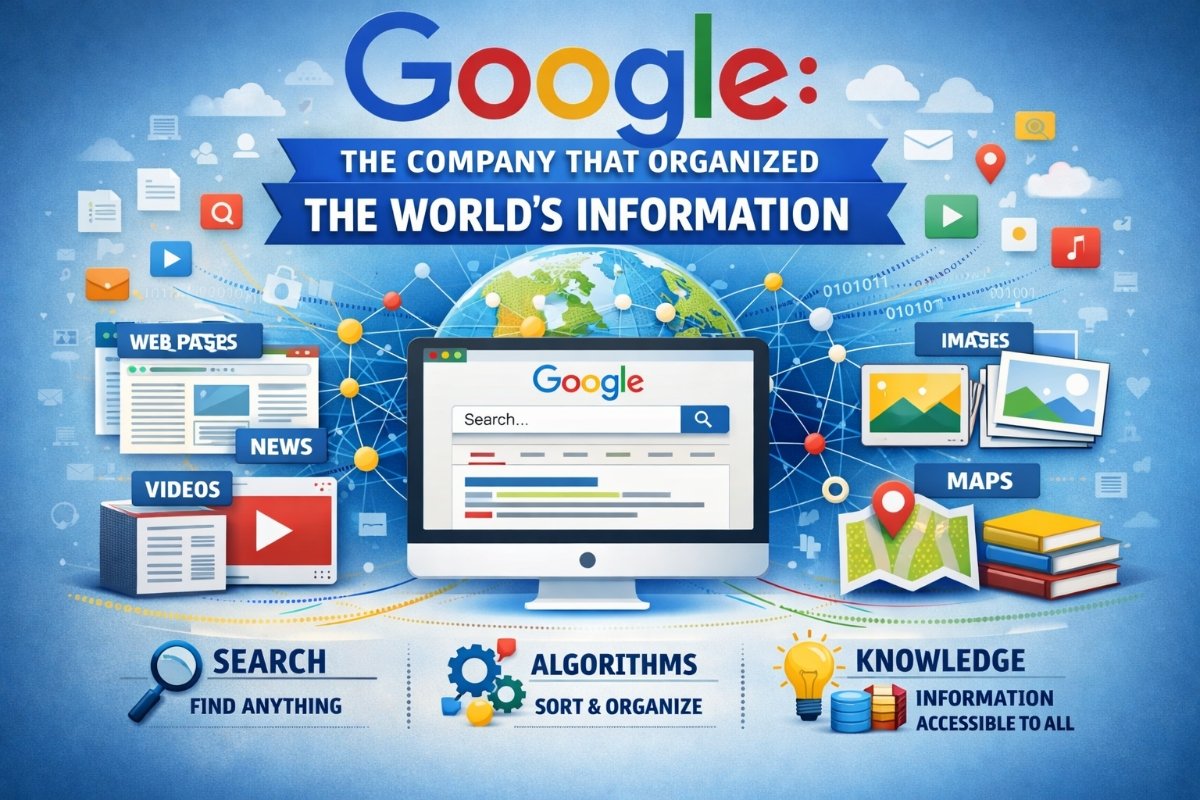
Few companies have reshaped human behavior as profoundly as Google. What began as an academic experiment in the late 1990s evolved into the primary gateway through which billions of people access information, navigate cities, communicate, work, and conduct business.
Today, Google is not merely a search engine. It is an infrastructure layer of modern life.
From answering simple questions to powering smartphones, mapping the planet, hosting videos, and advancing artificial intelligence, Google’s influence extends into nearly every corner of the digital world.
Understanding Google’s story is, in many ways, understanding the story of the modern internet itself.
Founders and Origin Story
Google was founded in 1998 by two PhD students at Stanford University:
Their partnership began in 1995 when Page visited Stanford and met Brin. Though they initially disagreed on many topics, they discovered a shared interest in solving a fundamental problem: finding relevant information on the rapidly expanding World Wide Web.
At the time, search engines existed, but they were inefficient. They ranked pages largely based on how often keywords appeared, making results easy to manipulate and often unreliable.
Page and Brin developed a new approach.
Their system, called PageRank, analyzed how web pages linked to one another. A page linked by many important sites was considered more valuable.
This idea transformed search.
Originally called “BackRub,” the project was renamed Google, derived from the mathematical term “googol,” meaning the number 1 followed by 100 zeros. The name reflected their mission: organizing vast amounts of information.
Google officially launched on September 4, 1998, operating from a rented garage in Menlo Park, California.
Early Growth and Breakthrough
Google’s rise was rapid but not accidental.
Its homepage was famously simple. While competitors filled their pages with news, ads, and distractions, Google focused on one thing: delivering the best search results.
Users noticed.
By 2000, Google was handling over one billion searches per day.
Its speed, accuracy, and clean design set it apart.
Another breakthrough came when Google introduced AdWords in 2000. Unlike traditional banner ads, Google displayed text ads related to search queries.
This model proved revolutionary.
It allowed advertisers to reach users actively searching for specific products or services.
And it made Google extraordinarily profitable.
Key Innovations and Products
Google’s influence expanded far beyond search.
Search Engine
Google Search remains its core product.
It processes hundreds of billions of searches monthly.
It answers questions, provides instant information, and connects users with websites worldwide.
Google’s algorithms have evolved continuously, incorporating machine learning and artificial intelligence.
Gmail
When Google launched Gmail in 2004, it disrupted email.
It offered:
- Massive storage
- Fast search
- Conversation threading
Gmail became one of the world’s most widely used email platforms.
Android
Google’s acquisition and development of Android transformed the mobile industry.
Today, Android powers most smartphones globally.
It allowed Google to extend its services into mobile computing.
YouTube
Google acquired YouTube in 2006.
It became the world’s largest video platform.
YouTube transformed media, entertainment, education, and news distribution.
Google Maps
Google Maps revolutionized navigation.
It allowed users to:
- Find directions
- Explore cities
- Discover businesses
It reshaped travel and commerce.
Google Chrome
Launched in 2008, Google Chrome became the world’s most popular browser.
It improved speed, security, and web application performance.
Business Model and Revenue
Google’s financial success is rooted in advertising.
Its primary platform, Google Ads, allows businesses to pay for visibility.
When users search for products or services, Google displays relevant ads.
Advertisers pay when users click.
This model, known as pay-per-click advertising, generates enormous revenue.
Google also earns money from:
- YouTube advertising
- Cloud services
- App store commissions
- Hardware products
Advertising remains its dominant income source.
Google generates hundreds of billions of dollars annually.
Major Acquisitions
Google’s growth has been fueled by strategic acquisitions.
DoubleClick
DoubleClick strengthened Google’s advertising infrastructure.
It helped Google dominate digital advertising.
DeepMind
DeepMind became central to Google’s artificial intelligence efforts.
It developed advanced AI systems capable of solving complex problems.
Android Inc.
The Android acquisition allowed Google to enter mobile computing.
It became one of Google’s most important strategic decisions.
Google’s Role in Modern Life
Google influences how people:
- Learn
- Communicate
- Navigate
- Work
- Shop
Businesses depend on Google visibility for customers.
Students use Google for education.
Travelers use Google Maps.
Professionals use Google Workspace.
Google has become part of everyday infrastructure.
Challenges and Controversies
Google’s power has also attracted criticism.
Privacy Concerns
Critics argue Google collects too much user data.
This includes:
- Search history
- Location
- Behavior
Privacy debates continue globally.
Antitrust Cases
Governments have accused Google of monopolistic practices.
Regulators argue Google unfairly favors its own services.
Multiple lawsuits have been filed.
Competition
Google faces competition from:
- Microsoft
- Apple
- Amazon
Especially in cloud computing and artificial intelligence.
Google’s Transformation into Alphabet
In 2015, Google reorganized under a new parent company:
This allowed Google to separate its core business from experimental projects.
Alphabet oversees ventures in:
- Artificial intelligence
- Health technology
- Autonomous vehicles
Google became Alphabet’s largest subsidiary.
Future of Google: Artificial Intelligence and Beyond
Google is now focused heavily on artificial intelligence.
AI powers:
- Search results
- Voice assistants
- Translation
- Image recognition
Google is developing advanced AI systems.
These technologies could reshape industries.
Google is also investing in:
- Quantum computing
- Autonomous vehicles
- Healthcare technology
Its future extends beyond search.
Conclusion: A Company That Reshaped Human Knowledge
Google began as a student project.
It became one of the most powerful companies in history.
Its innovations reshaped information access, communication, and commerce.
Google helped define the internet age.
Its next chapter, driven by artificial intelligence, may define the future.
FAQ
Enjoyed this Big Story on Google?
We would love to hear your thoughts. Contact us and tell us which company, innovator, or global story you want BigStories.net to cover next.