



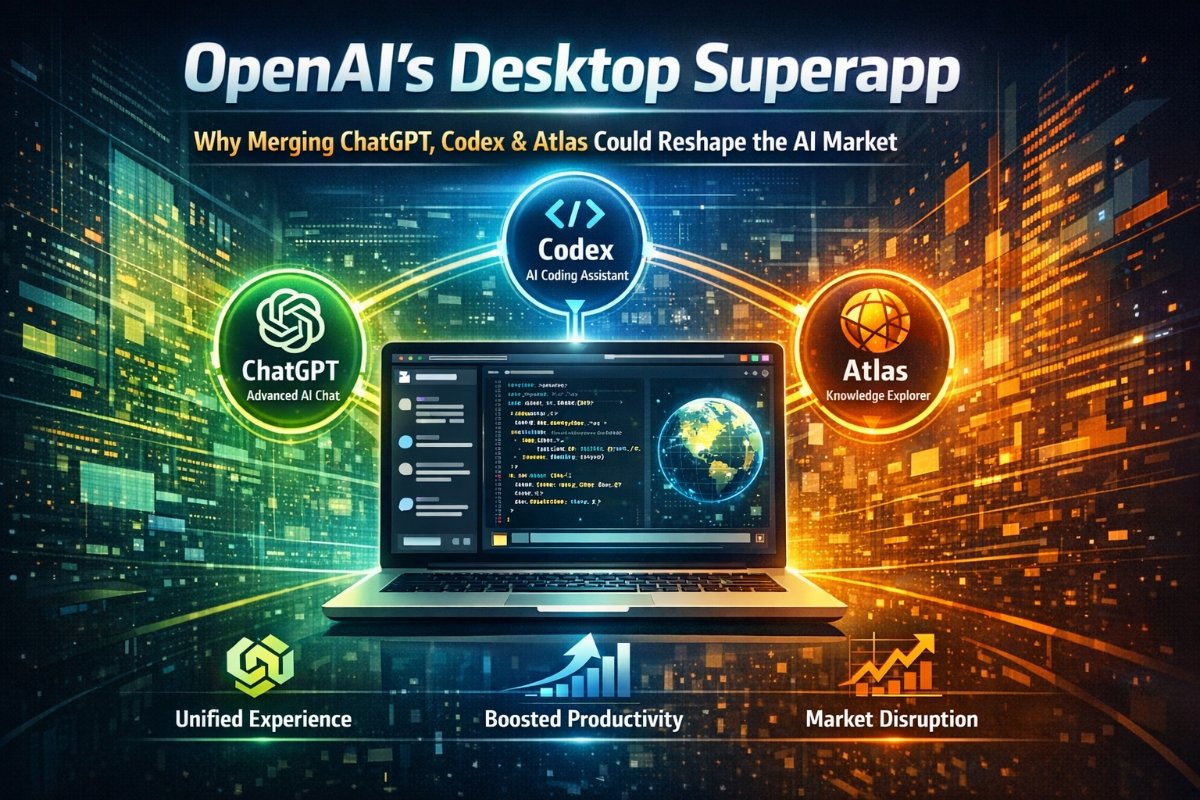
OpenAI just made one of the most consequential product decisions in its history — and it has nothing to do with a new model. On March 19, 2026, the company confirmed it will merge its ChatGPT app, Codex coding platform, and Atlas browser into a single desktop “superapp.” In a market where AI companies are racing to ship more products faster, OpenAI is doing the opposite: consolidating everything into one.
This isn’t just a UX redesign. It’s a strategic pivot that signals how OpenAI plans to compete as a platform company heading into a potential IPO — and it reveals more about the state of the AI race than any benchmark ever could.
What Exactly Is Happening?
OpenAI’s Chief of Applications Fidji Simo and President Greg Brockman are leading the effort. Simo will steer the product and sales transition, while Brockman will temporarily oversee the organizational restructuring required to pull it off.
The internal reasoning is blunt. In an internal memo reported by The Wall Street Journal, Simo told employees that OpenAI had been spreading its engineering resources across too many standalone products, and that the resulting fragmentation was hurting both speed and quality. She followed up publicly on X, noting that while exploration phases are necessary, the company now needs to consolidate around what’s actually working.
The three products being unified each serve distinct functions today. ChatGPT is the conversational AI interface used by hundreds of millions. Codex is the AI-powered coding tool OpenAI launched as a standalone desktop app earlier this year. Atlas is the company’s AI-driven web browser. Under the superapp model, users would handle conversations, programming, and web-based tasks within a single application instead of switching between three.
The mobile ChatGPT app, notably, remains unaffected for now.
The Numbers That Make This Move Inevitable
To understand why OpenAI is consolidating, you have to look at where the company stands financially and competitively — because the data tells a story of a company that’s grown so fast, its product surface area can’t keep up.
User Scale
OpenAI’s user base is staggering. ChatGPT now has roughly 800 to 900 million weekly active users globally, with some estimates pushing toward the 900 million mark as of early 2026. The platform processes approximately 2.5 billion prompts per day. To put that in context, ChatGPT is now one of the top six most-visited websites in the world, rivalling platforms like Instagram in monthly traffic.
Here’s a snapshot of the growth trajectory:
| Period | Weekly Active Users | Monthly Visits |
|---|---|---|
| November 2023 | ~100 million | ~1.7 billion |
| December 2024 | ~300 million | ~3.8 billion |
| July 2025 | ~700 million | ~5.0 billion |
| October 2025 | ~800 million | ~5.5 billion |
| Early 2026 | ~900 million | ~5.7 billion |
Sources: TechCrunch, Backlinko, Similarweb, DemandSage
Revenue Trajectory
OpenAI hit $10 billion in annual recurring revenue by mid-2025. By February 2026, third-party estimates peg the company’s annualized revenue at around $25 billion, up from $20 billion at the end of 2025. The company is targeting $29.4 billion in full-year 2026 revenue.
The revenue mix is heavily subscription-driven: ChatGPT Plus, Pro, Team, Enterprise, and Edu plans collectively serve more than 9 million paying business users as of February 2026. Consumer in-app revenue alone grew by nearly 592% in the twelve months leading up to March 2025.
The Desktop Factor
Here’s a data point that makes the superapp decision particularly logical: approximately 72% of ChatGPT users access the platform from a desktop rather than mobile. This isn’t a mobile-first audience. It’s a productivity-first audience — people at work, writing code, doing research, building documents. A unified desktop app isn’t a nice-to-have for this user base; it’s arguably long overdue.
The Anthropic Problem
OpenAI’s consolidation isn’t happening in a vacuum. Multiple reports, including the original Wall Street Journal piece, explicitly flag the rising threat from Anthropic as a motivating factor.
The numbers explain why. Anthropic’s annualized revenue reportedly reached around $19 billion by early 2026, a dramatic surge from approximately $4 billion in mid-2025. Claude Code has gained significant traction among developers, and Anthropic’s enterprise-focused positioning has been peeling away business customers who value reliability and a narrower, more polished product suite.
Here’s the competitive snapshot:
| Metric | OpenAI (Early 2026) | Anthropic (Early 2026) |
|---|---|---|
| Annualized Revenue | ~$25 billion | ~$19 billion |
| Valuation | ~$500 billion | ~$61 billion |
| Weekly Active Users (Consumer) | ~900 million | Not disclosed |
| Enterprise Focus | Broadening | Core strategy |
| Product Strategy | Consolidating (superapp) | Focused (Claude platform) |
Sources: Sacra, Backlinko, Business of Apps, Reuters
The irony is notable: Anthropic’s more focused product strategy may have inadvertently forced OpenAI to adopt a similar philosophy — fewer products, deeper integration, higher quality per surface.
The Superapp Gamble: Why Western Markets Are Skeptical
If you’ve followed the tech industry for the past decade, the word “superapp” probably triggers some skepticism — and for good reason.
In Asia, superapps like WeChat and Grab have thrived by bundling messaging, payments, ride-hailing, shopping, and government services into a single interface. But every major attempt to replicate this model in Western markets has struggled. Facebook tried to turn Messenger into a platform. Uber attempted to expand beyond ride-hailing into freight, groceries, and financial services. Snapchat bolted on mini-apps. None of these achieved true superapp status.
The pattern is clear: Western users tend to prefer specialized tools over all-in-one bundles. They’d rather use Slack for messaging, Chrome for browsing, and VS Code for coding than have all three crammed into one application.
So why might OpenAI’s version be different?
The argument rests on a fundamental distinction: the products being merged aren’t three unrelated services. They’re three interfaces to the same underlying AI. When you chat with ChatGPT, browse with Atlas, or code with Codex, you’re interacting with variations of the same model infrastructure. The “app-switching” that users do today between these tools is arguably artificial — a consequence of how OpenAI shipped products, not how users actually want to work.
If the superapp can create a seamless flow where a single conversation context moves from research (browsing) to analysis (chat) to implementation (code) without losing context, that’s not a bloated Swiss army knife. That’s a genuine workflow improvement.
The IPO Dimension
There’s another layer to this decision that goes beyond product strategy: OpenAI is widely expected to pursue an IPO as early as late 2026 or 2027. The company recently hired its first head of investor relations, and its $500 billion valuation makes it one of the most valuable private companies in history.
For an IPO-stage company, product fragmentation is a liability. Investors want to see a clear, unified revenue engine — not a portfolio of experiments. A single superapp with a coherent user journey from free tier to enterprise contract tells a much cleaner growth story than three separate products with overlapping user bases and independent development teams.
Simo’s appointment from Instacart (where she served as CEO) and her emphasis on “product focus and discipline” fits this narrative precisely. Her internal message about avoiding “side quests” reads as much like IPO preparation as product strategy.
What This Means for Users and Developers
For everyday ChatGPT users, the immediate impact is likely minimal. The mobile app isn’t changing, and the core chat experience will presumably remain the anchor of the new desktop app.
For developers using Codex, however, this is a significant shift. Codex was launched as a standalone desktop tool specifically to compete in the AI code-generation market. Folding it back into a broader app raises questions about whether it will retain the deep, purpose-built features that developers need, or whether it’ll become a tab inside a larger product.
For enterprise customers — the 92% of Fortune 500 companies already using ChatGPT — a unified app could actually simplify procurement and deployment. One product to license, one security surface to audit, one tool to train employees on.
Things to watch going forward:
- Context continuity. Can the superapp maintain a single conversation thread across chat, browsing, and coding? That’s the killer feature.
- Performance. Bundling three apps into one risks creating a resource-heavy desktop application. Electron fatigue is real.
- Developer tools. If Codex loses its standalone identity, will power users migrate to competitors like Claude Code or Cursor?
- Timeline. No launch date has been announced. The organizational restructuring alone will take months.
The Verdict: Smart Strategy, Hard Execution
OpenAI’s superapp move is strategically sound. The data supports it — the desktop-heavy user base, the revenue consolidation logic, the IPO optics, and the competitive pressure from Anthropic all point in the same direction. Merging products around a single AI backbone is fundamentally different from the failed Western superapp attempts of the past, which tried to bundle unrelated services.
But strategy and execution are different things. The risk isn’t the idea of a superapp — it’s the transition. OpenAI has to merge three engineering teams, three product roadmaps, and three user expectations without alienating the power users who chose each tool for specific reasons. Simo and Brockman have the organizational authority to make it happen. Whether they can do it without a quality dip during the most competitive moment in AI history will determine if this becomes a case study in focus or a cautionary tale about premature consolidation.
One thing is certain: the era of OpenAI shipping fast and figuring it out later is over. What comes next is a company trying to prove it can build a platform, not just a product.
Frequently Asked Questions
What is OpenAI’s superapp?
OpenAI’s superapp is a planned unified desktop application that will combine three currently separate products — ChatGPT (conversational AI), Codex (AI coding tool), and Atlas (AI-powered browser) — into a single integrated experience. The goal is to reduce product fragmentation and create a seamless workflow for users.
When is the OpenAI superapp launching?
OpenAI has not announced a specific launch date as of March 2026. The company is currently in the organizational restructuring phase, with President Greg Brockman overseeing the product overhaul. Given the scope of the merger, a rollout in late 2026 seems likely, but no timeline has been confirmed.
Will the ChatGPT mobile app change?
No. According to reports from The Wall Street Journal, the mobile version of ChatGPT will remain unaffected by the superapp consolidation. The merger applies specifically to the desktop product experience.
How does OpenAI’s superapp compare to WeChat or other superapps?
Unlike traditional superapps that bundle unrelated services (messaging, payments, ride-hailing), OpenAI’s superapp merges three products that share the same underlying AI infrastructure. The consolidation is more about unifying interfaces to a single technology than combining different businesses under one roof.
So, this was the BigStory of OpenAI’s boldest product bet yet — a desktop superapp that could quietly reshape how hundreds of millions of people interact with artificial intelligence every day. At BigStories, our goal is to bring you the strategies, data, and decisions behind the companies and ideas redefining the future. If you found this analysis useful, consider sharing it with fellow builders, developers, and anyone watching the AI race unfold in real time, and explore more BigStories that break down how tomorrow’s technology landscape is being shaped today.