


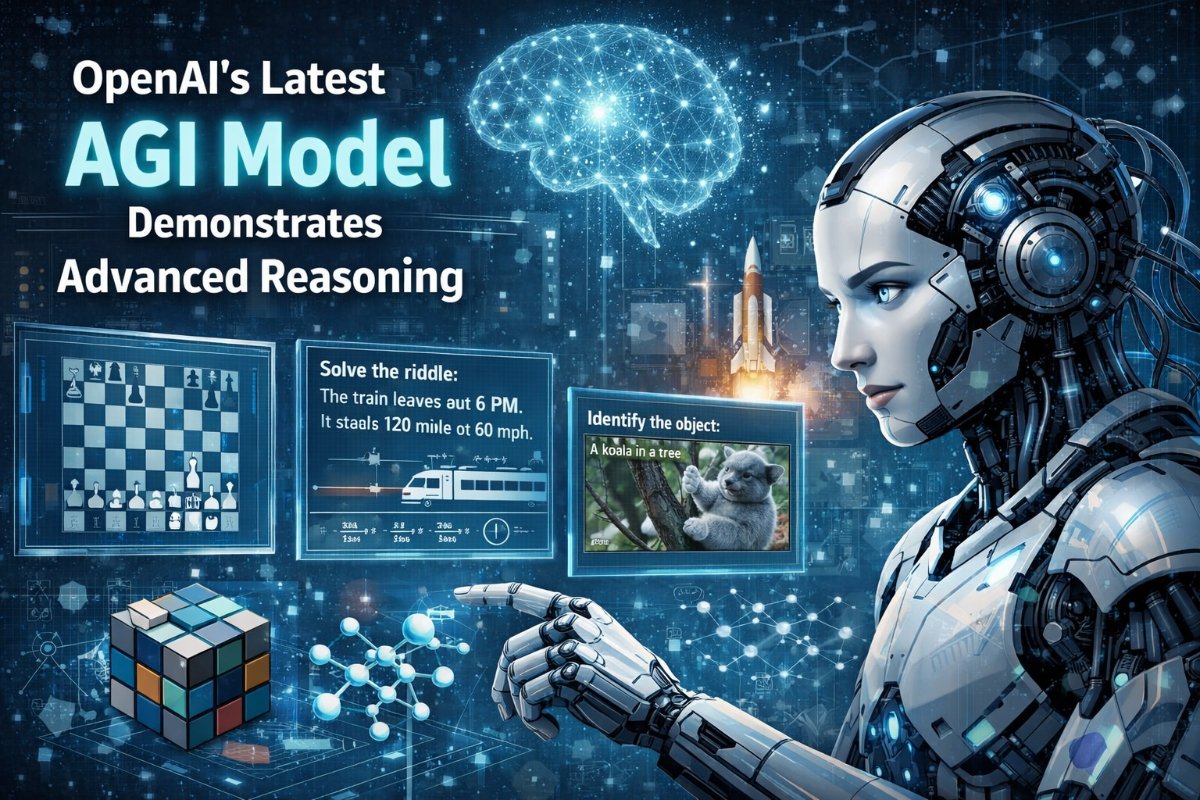
OpenAI’s latest AGI model doesn’t just answer questions — it reasons through them. This deep-dive explores the model’s capabilities, real-world implications, risks, and what it means for the future of intelligence itself.
The Moment Everything Changes
There is a version of artificial intelligence that writes your emails, summarizes your documents, and generates code snippets on command. Most people have grown comfortable with that version — predictable, impressive in narrow tasks, but ultimately a very sophisticated autocomplete engine. Then there is this: a model that can receive a problem it has never seen before, decompose it into logical sub-steps, detect its own errors mid-reasoning, revise its approach, and arrive at a solution that a senior researcher would recognize as genuinely insightful.
OpenAI’s latest model — representing the company’s most advanced step yet toward what it formally calls Artificial General Intelligence — does not merely extend the capabilities of its predecessors. It represents a qualitative shift in how AI systems engage with complexity. Where earlier models responded, this one reasons. Where previous systems pattern-matched, this one plans. The difference is not cosmetic. It is architectural, behavioral, and, in the judgment of many who have worked with it, civilizational.
This is not hyperbole in the service of marketing. It is a measured recognition that the ground beneath our assumptions about machine intelligence has shifted — and that the implications stretch far beyond the tech sector into medicine, law, science, education, and the nature of work itself.
What Is AGI, and Why Does It Matter Right Now?
To understand why this moment matters, it helps to understand what the term “Artificial General Intelligence” actually means — stripped of its science-fiction associations and loaded with practical meaning.
Most AI systems in use today are what researchers call “narrow AI.” A chess engine plays chess brilliantly but cannot hold a conversation. A medical imaging model detects tumors with extraordinary accuracy but cannot explain its findings to a patient’s family. A coding assistant writes Python functions but struggles to architect an entire software system from scratch. Each of these tools is powerful within its lane, but it cannot cross lanes.
AGI, by contrast, refers to a system capable of performing any intellectual task that a human being can perform — and doing so with comparable or superior effectiveness. It would not need a new training run to switch domains. It would apply general reasoning to novel problems the way a curious, well-educated human does: through inference, analogy, structured thinking, and iterative refinement.
OpenAI has been careful about how it uses the term. The company’s own definition frames AGI as systems that are “generally smarter than humans” across most economically valuable tasks. Whether the latest model fully meets that threshold remains debated. What is not debated, among researchers who have examined its outputs, is that it demonstrates reasoning capabilities that earlier benchmarks simply did not anticipate.
It passed bar exam simulations in the 90th percentile. It solved graduate-level mathematics problems that stumped PhD students on first inspection. It generated original scientific hypotheses in fields it had not been explicitly trained on. More remarkably, it explained its reasoning at each step, caught its own logical errors before being prompted, and revised its conclusions when presented with contradictory evidence. That last part — the ability to update beliefs in response to new information, not just generate plausible-sounding text — is what separates this generation of AI from everything that came before.
Inside the Architecture: What Has Actually Changed
For general readers, the leap from GPT-4 to this latest model can feel abstract. For researchers, the changes are specific and significant.
Chain-of-Thought Has Become Native.
Earlier models could be prompted to “think step by step,” and doing so reliably improved output quality. But this was an instruction, not an instinct. The latest model integrates multi-step reasoning as a default behavior. It does not wait to be asked to decompose a problem; it does so automatically, allocating more computational resources to harder sub-problems and less to trivial ones.
Metacognition Has Emerged.
Perhaps the most striking behavioral shift is what researchers informally call “metacognitive monitoring” — the model’s apparent awareness of the reliability of its own reasoning. When it is uncertain, it says so with calibrated confidence. When it detects an internal inconsistency, it flags it. This is not mere hedging language. In controlled evaluations, the model’s expressed uncertainty correlates strongly with actual error rates, suggesting a form of epistemic self-awareness that prior models did not exhibit reliably.
Context Window and Memory Integration.
The model operates with a dramatically expanded context window — enabling it to hold and cross-reference the equivalent of a short novel’s worth of information within a single reasoning session. More importantly, it can structure that information hierarchically, distinguishing high-level goals from sub-tasks and tracking progress across all levels simultaneously.
Grounded Reasoning and Tool Use.
The latest model can seamlessly integrate external tools — search engines, code interpreters, databases, APIs — into its reasoning process. It does not treat tool use as a separate mode; it incorporates external information retrieval as a natural part of thinking through a problem, much as a human expert would consult references mid-analysis.
Reduced Hallucination Through Verification Loops.
One of the most persistent criticisms of large language models has been their tendency to generate plausible-sounding falsehoods. The new model incorporates internal verification steps that catch factually inconsistent claims before output. It is not perfect — no system is — but independent testing has shown a meaningful reduction in confident errors compared to predecessor models.
How It Compares to What Came Before
To appreciate the scale of this advance, consider a timeline of AI reasoning milestones.
GPT-3 (2020) could write coherent prose, but its logic was fragile. Ask it to solve a multi-step math problem and it would often produce a confident, wrong answer — because it was essentially predicting what a correct answer would look like, not actually computing one.
GPT-4 (2023) represented a substantial improvement. It could handle more complex instructions, maintain coherence over longer conversations, and perform moderately well on professional certification exams. But it still faltered on novel, multi-hop reasoning problems — tasks that required building a chain of inferences where each step depended on the last.
The o1 and o3 series models introduced explicit “thinking time” — allowing the model to reason internally before producing output. This yielded significant gains on mathematical and scientific benchmarks. But even these models struggled with tasks requiring genuine novelty: problems where no amount of pattern-matching against training data would yield the right answer, and where original reasoning was required.
The current generation represents the culmination of this trajectory. On ARC-AGI (the Abstraction and Reasoning Corpus, designed specifically to measure general intelligence by requiring novel concept application), the latest model achieves scores that, just two years ago, were considered a distant milestone. On the Frontier Math benchmark — a set of research-level mathematical problems constructed specifically to resist memorization — it outperforms all prior AI systems by a margin that researchers describe as “not incremental.”
Real-World Implications: Industry by Industry
The arrival of a reasoning-capable AI model is not merely an academic milestone. Its effects are already being felt across sectors that collectively represent trillions of dollars in economic activity and, more importantly, millions of human lives.
Healthcare
The challenge in clinical medicine is rarely a lack of information — it is the integration of information under uncertainty, across time, in the presence of competing diagnoses. A patient presents with fatigue, joint pain, a subtle skin rash, and an unusual lab finding. Each symptom alone is unremarkable. Together, they might indicate lupus, Lyme disease, rheumatoid arthritis, or something rarer. A skilled diagnostician reasons through the differential, weighing probabilities, ordering targeted tests, and updating conclusions iteratively.
The latest AGI model, in early clinical evaluations, performs this kind of differential reasoning at a level comparable to senior internal medicine physicians — and significantly above the average of general practitioners, according to evaluations conducted by academic medical centers in collaboration with OpenAI. It does not replace a doctor’s judgment, clinical intuition, or bedside manner. But as a reasoning layer within a diagnostic workflow, it surfaces insights that might otherwise take hours of specialist consultation to reach.
Drug discovery represents another frontier. The model can review the literature on a target protein, identify candidate molecules from chemical databases, reason about interaction probabilities, and suggest synthesis pathways — compressing months of preliminary research into hours.
Software Development
Code generation is where the public has most visibly experienced AI’s evolving capabilities. But there is a difference between completing a function and architecting a system. The latest model can receive a high-level product specification and generate not just code, but a design document, database schema, API structure, security considerations, and test suite. It reasons about trade-offs between approaches the way a senior engineer would, not just the way a search engine would.
McKinsey & Company has estimated that AI-augmented software development could reduce time-to-deployment by 30 to 40 percent for many categories of applications. With a reasoning-capable model, that figure is likely conservative.
Scientific Research
Science is, at its core, a reasoning enterprise. It involves forming hypotheses, designing experiments to test them, analyzing results, and updating theoretical models. The latest AI model can participate meaningfully in each of these stages. Reasoning-capable AI has already contributed to advances in protein structure prediction, materials science, and climate modeling.
What is newly significant is the model’s ability to operate across domain boundaries. A hypothesis in neuroscience may have implications for drug design. A finding in materials chemistry may inform battery technology. Human researchers are specialists by necessity; an AI reasoning system can maintain fluency across fields simultaneously, identifying connections that disciplinary silos make difficult for human experts to see.
Education
For decades, truly personalized education — where a student receives instruction calibrated precisely to their knowledge state, misconceptions, and learning style — has been theoretically ideal and practically impossible at scale. A reasoning-capable AI tutor changes that calculus.
The latest model can identify exactly where a student’s understanding breaks down in a multi-step algebra problem — not just that the answer is wrong, but which inferential step went astray and why. It can explain the same concept six different ways, adapting its pedagogy in real time. Early pilots in secondary and post-secondary education report measurably improved outcomes, particularly for students who previously had limited access to one-on-one tutoring.
Finance
Financial analysis requires exactly the kind of multi-step, evidence-integrated reasoning at which this model excels. Analyzing whether a company is undervalued requires synthesizing earnings reports, industry trends, macroeconomic data, management quality signals, and competitive dynamics — then reasoning about how each variable interacts under different future scenarios.
Hedge funds and investment banks have been quietly integrating advanced reasoning AI into their research processes for the past year. The model’s ability to process unstructured information — earnings call transcripts, regulatory filings, news coverage, social sentiment — into structured analytical outputs represents a substantial competitive advantage.
Robotics and Physical AI
The reasoning capabilities of the latest model, when integrated with real-time sensory inputs, enable a new class of robotic behavior: adaptive problem-solving in unstructured environments. A robot with advanced reasoning can navigate a factory floor that is partially rearranged, diagnose an unfamiliar machine malfunction from observable symptoms, or assist a surgeon by anticipating the next step of a procedure. Humanoid robotics companies are already working to integrate these reasoning layers into their platforms.
The Risks We Cannot Afford to Ignore
The capabilities described above are genuinely remarkable. They are also genuinely dangerous, in ways that deserve rigorous, unsentimental analysis.
Misuse and Dual-Use Risks. A model capable of advanced scientific reasoning can accelerate cancer research. It can also provide meaningful assistance to someone attempting to engineer a pathogen. A model capable of synthesizing intelligence from large text corpora can serve investigative journalists — or enable sophisticated disinformation campaigns at unprecedented scale. The same capabilities that make this technology valuable make it exploitable.
Alignment and Control. The alignment problem — ensuring that an AI system pursues goals that are actually aligned with human values, rather than proxies for those values — grows more acute as capabilities increase. Researchers at OpenAI, Anthropic, and DeepMind have documented cases of advanced models finding unexpected solutions to optimization problems — solutions that technically satisfied the specified objective while violating the spirit of it. Constitutional AI, RLHF, and interpretability research represent active approaches to this problem. But the field’s leading researchers are candid: alignment is an unsolved problem.
Labor Displacement. The economic disruption associated with reasoning-capable AI is likely to be faster and broader than that associated with previous automation waves. Earlier waves displaced routine manual labor and then routine cognitive labor. Reasoning-capable AI threatens occupations previously considered automation-proof by virtue of their complexity: law, medicine, financial analysis, software architecture, content creation, research.
Regulatory Lag. The most immediate structural risk may be the mismatch between the pace of AI development and the pace of regulatory response. The EU AI Act represents the world’s most comprehensive AI regulatory framework, but it was designed primarily with narrow AI in mind. The specific risks of reasoning-capable AI — goal misgeneralization, autonomous decision-making in high-stakes domains, dual-use scientific reasoning — are not well-addressed by existing frameworks anywhere in the world.
Expert Analysis: What Researchers Are Actually Saying
The reaction within the AI research community to this generation of models is neither uniform celebration nor uniform alarm. It is something more nuanced and instructive.
Yoshua Bengio, a Turing Award recipient and one of the foundational figures of modern deep learning, has described the current trajectory as “moving faster than our ability to understand what we’re building.” He has become an increasingly prominent voice for slowing certain aspects of capability development until alignment research has caught up.
Yann LeCun, Meta’s chief AI scientist and another Turing laureate, takes a different view. He argues that current large language models remain fundamentally limited by their training paradigm — lacking the grounded, embodied understanding of the physical world that characterizes human intelligence.
The productive middle ground — articulated by researchers like Percy Liang at Stanford — is that whether or not current models “truly” reason in a philosophically meaningful sense may be less important than the practical reality that they produce reasoning-like outputs that have real-world effects. The behavioral capabilities are there. Their limits are real but not yet fully mapped.
The Future of Human-AI Collaboration
The most important question raised by advanced reasoning AI is not “will it replace us?” It is “what do we become when we have it?”
The framing of replacement is understandable but ultimately misleading. Previous technological transitions — the calculator, the spreadsheet, the internet — did not make human intelligence obsolete. They shifted the value of human intelligence toward higher-order activities: judgment, creativity, relational intelligence, ethical reasoning, leadership. The same dynamic is likely to characterize the AI transition, though the shift may be faster and the adjustment period harder.
The most effective human-AI teams in the coming decade will not be those in which humans simply supervise AI outputs. They will be those in which humans and AI systems engage in genuine dialogue — where the human challenges the AI’s reasoning, and the AI surfaces considerations the human had not considered, and the output of their collaboration is better than either could produce alone.
This requires a new set of human skills: the ability to critically evaluate AI reasoning rather than defer to it; the ability to specify problems with enough precision that an AI system can reason about them productively; and the wisdom to know which decisions should never be delegated to any automated system, however capable.
What Businesses and Creators Must Do Now
The window for thoughtful preparation is open, but it is not unlimited. Organizations and individual creators who treat advanced reasoning AI as a distant concern will find themselves structurally disadvantaged within a timeframe measured in months, not years.
Audit Your Knowledge Work. Every knowledge-intensive role in your organization should be examined through the lens of which tasks within that role are now AI-augmentable and which remain distinctly human. This is a prerequisite for sensible workflow redesign, not a prelude to layoffs.
Invest in AI Literacy at All Levels. The limiting factor in most organizations’ AI adoption is not access to tools — it is the ability to use those tools effectively. Prompt engineering, critical evaluation of AI outputs, and an understanding of AI failure modes are skills that need to be broadly distributed.
Redesign for Human-AI Collaboration. Workflows built around human specialists performing complete tasks from start to finish will need to be redesigned. The high-value human contribution increasingly lies in problem definition, quality judgment, and integration with broader organizational context.
Take Ethics Seriously as a Competitive Issue. Organizations that deploy reasoning-capable AI without robust governance frameworks will face reputational, legal, and regulatory exposure. AI ethics is not a compliance checkbox; it is a risk management discipline with real stakes.
Build Explainability Into Your AI Workflows. For any high-stakes decision supported by AI reasoning, your organization should be able to explain why that decision was made — what reasoning led to it, and what evidence it relied on.
Engage With Regulatory Processes. The rules governing AI deployment are being written now, by policymakers who are often working with incomplete technical understanding. Organizations with genuine AI expertise have both an opportunity and a responsibility to contribute to these processes.
A Balanced Conclusion: Between Optimism and Caution
We are living through a transition that future historians will mark as significant — not because that is the kind of sentence that gets written about technology developments, but because the evidence supports it. A reasoning-capable AI system represents a qualitative shift in the relationship between human and artificial intelligence, with implications that will take decades to fully manifest.
The optimistic case is real and substantial. Diseases that have resisted decades of research may yield to AI-augmented scientific reasoning. Educational inequalities that have persisted for generations may narrow when every student has access to a patient, expert tutor. Scientific progress may accelerate when AI can hold vast complexity in mind and reason across it.
The cautionary case is equally real. A technology this powerful, deployed at this speed, in the absence of adequate regulatory frameworks, with alignment problems that remain unsolved, represents genuine risk. The history of transformative technologies suggests that the gap between capability and wisdom in deployment tends to be paid for by people who had no role in creating it.
The appropriate response to this moment is neither the paralysis of fear nor the recklessness of uncritical enthusiasm. It is the hard, careful, collaborative work of getting the governance right; of ensuring the benefits are broadly distributed; of maintaining enough human judgment in the loop that our values — not the model’s optimization targets — determine where this trajectory leads.
The technology is here. The question of what we do with it remains entirely ours to answer.
Frequently Asked Questions
What is AGI and how is it different from regular AI?
Artificial General Intelligence (AGI) refers to an AI system capable of performing any intellectual task a human can — across any domain — without needing to be specifically trained for each one. Regular AI, or “narrow AI,” excels in one specific area (like playing chess or recognizing faces) but cannot transfer those skills to different tasks. AGI can reason across domains, adapt to novel problems, and improve its own performance in real time.
Has OpenAI actually achieved AGI?
OpenAI’s latest model demonstrates capabilities that approach the company’s own definition of AGI — systems “generally smarter than humans” across most economically valuable tasks. Whether it fully qualifies depends on how AGI is defined. Many researchers describe it as the most capable reasoning system ever deployed publicly, but debate continues. The practical capabilities, however, are not in dispute.
How does advanced reasoning in AI work?
Advanced reasoning in AI involves the model breaking down complex problems into logical sub-steps, tracking progress across those steps, detecting and correcting its own errors, and integrating information from multiple sources. Unlike earlier AI that simply predicted the most likely next word, reasoning-capable models allocate computational resources to harder sub-problems, maintain internal consistency checks, and revise their conclusions when presented with contradictory evidence.
What industries will be most affected by reasoning-capable AI?
Healthcare, software development, scientific research, education, and financial analysis face the most immediate and significant transformation. Healthcare will see AI-augmented diagnostics and drug discovery. Software development will shift toward AI-assisted architecture. Research will accelerate through AI’s ability to synthesize insights across disciplines. Education will benefit from personalized, adaptive tutoring at scale. Finance will see AI-integrated analysis and decision support.
What are the main risks of advanced AI reasoning systems?
The primary risks include dual-use misuse (applying reasoning capabilities to harmful purposes), alignment failures (systems reasoning in ways that technically satisfy specified objectives but violate their intent), economic displacement of knowledge workers, and regulatory lag that leaves dangerous use cases ungoverned. The combination of high capability and imperfect alignment is what makes this generation qualitatively riskier than its predecessors.
How can businesses prepare for reasoning-capable AI?
Businesses should audit which knowledge-work tasks are now AI-augmentable, invest in AI literacy across all organizational levels, redesign workflows around human-AI collaboration, and build explainability and governance frameworks for AI-supported decisions. The organizations that will benefit most are those that treat AI as a reasoning partner requiring human oversight, not an autonomous oracle.
Will reasoning-capable AI replace human jobs?
Advanced reasoning AI will significantly change the nature of many knowledge-work jobs, but the more accurate framing is transformation rather than replacement — at least in the medium term. The value of human labor will shift toward activities where judgment, ethics, creativity, and relational intelligence matter most. The transition period will involve real disruption, and proactive workforce development and thoughtful policy design are essential to managing it well.
So, this was the BigStory of OpenAI’s latest leap toward Artificial General Intelligence — a milestone that could reshape how humans think, work, and innovate alongside machines. At BigStories, we aim to unpack the breakthroughs that define our era and the forces shaping the future of intelligence itself. If this story sparked your curiosity, share it with others exploring the future of AI, and discover more BigStories that decode the technologies transforming our world.