


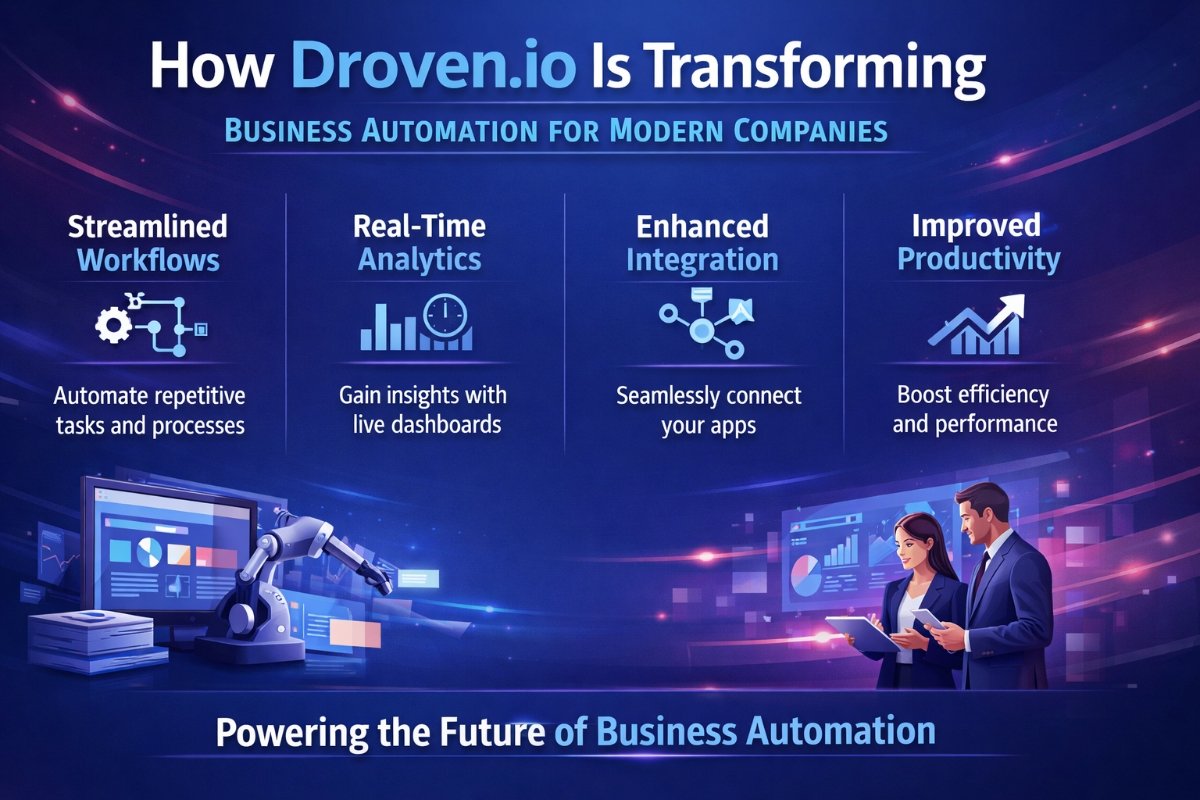
As AI automation reshapes how businesses operate, a growing number of owners and executives are turning to Droven.io — a free, US-focused knowledge platform — to cut through vendor noise, evaluate tools objectively, and build practical automation strategies. With enterprise AI adoption now at 88% but fewer than 1% of companies reporting mature deployments [1], the gap between buying automation and succeeding with it has never been wider. Droven.io automation resources address that gap directly.
Quick Snapshot
- Droven.io is not a software vendor. It is a free, vendor-neutral knowledge platform that publishes educational content on AI tools, RPA (Robotic Process Automation), workflow automation, and emerging technology [2] [Company-provided].
- The automation market is overwhelming. With the hyperautomation software market projected to reach $1.04 trillion by 2026 [3], business owners face hundreds of competing platforms and conflicting claims.
- Most businesses are stuck in pilot mode. McKinsey reports that only 1% of companies consider their AI deployments mature, even though 88% use AI in at least one function [1]. Making informed decisions before investing is critical.
- Droven.io fills an information gap. Rather than selling software, the platform provides unbiased tool comparisons, practical RPA breakdowns, and strategy guides aimed at non-technical decision-makers [2] [Company-provided].
- Content is structured for action. Articles cover tool directories, workflow design, vendor evaluation frameworks, and industry-specific automation use cases — all written for business owners, not engineers [4] [Company-provided].
What Is Droven.io?
Droven.io is an informational digital platform dedicated to publishing educational content on artificial intelligence, automation, RPA, and technology trends [2] [Company-provided]. It launched with a clear distinction from the crowded automation vendor landscape: it does not sell software, offer SaaS subscriptions, or provide consulting services. Instead, it operates as a curated knowledge hub.
The platform’s primary audience includes business owners, digital marketers, startup founders, and IT professionals in the United States. Its content is organised around several core pillars: AI tool directories and comparisons, RPA education broken into actionable stages, workflow automation strategy guides, and coverage of emerging trends such as agentic AI and no-code platforms [4] [Company-provided].
How the Platform Is Structured
Droven.io organises its content into distinct categories that map to real business decisions. The AI tools directory covers automation solutions for content creation, SEO, data processing, and workflow management [4] [Company-provided]. Software comparison articles evaluate related tools side by side, helping readers assess features without spending hours on independent research [5] [Company-provided].
The platform’s RPA content is particularly detailed. It breaks robotic process automation into four clear operational stages: task identification (recognising repetitive, rule-based processes), workflow creation (mapping automation steps and exception handling), bot training (replicating human actions at the screen or API level), and execution and monitoring (tracking error rates, processing speed, and accuracy) [2] [Company-provided].
This educational approach positions Droven.io as what industry analysts might call a “decision intelligence layer” — a resource that helps business owners understand their options before committing capital to any specific vendor or platform.
Key Reasons Business Owners Turn to Droven.io
Vendor-Neutral Guidance in a Noisy Market
The automation market is crowded and growing rapidly. Gartner projects the hyperautomation-enabling software market will reach nearly $1.04 trillion by 2026, growing at a compound annual growth rate (CAGR) of 11.9% [3]. Meanwhile, the RPA software market alone grew 14.5% to $3.6 billion in 2024, with UiPath, Microsoft, and Automation Anywhere leading [6].
For a business owner evaluating options, this creates a paradox of choice. Every vendor claims to be the most integrated, the fastest to deploy, or the most cost-effective. Droven.io addresses this by publishing comparison content that is not tied to any vendor’s commercial interests [2] [Company-provided]. The platform explicitly avoids promotional language and instead prioritises factual, structured evaluations that help readers form their own conclusions.
Bridging the Knowledge Gap for Non-Technical Leaders
McKinsey’s 2025 State of AI report revealed a striking disconnect. While 88% of organisations now use AI in at least one business function and 72% report using generative AI, nearly two-thirds have not begun scaling AI across the enterprise [1]. Only about 6% of respondents qualify as “high performers” seeing meaningful financial returns from AI [1].
One of the primary barriers is not technology — it is understanding. Many business owners lack the technical background to evaluate whether an RPA platform, a no-code workflow builder, or a full enterprise automation suite is the right fit. Droven.io’s content is written in accessible, jargon-free language specifically for this audience. Technical concepts such as API integrations (connections between software systems), machine learning models (algorithms that improve from data), and workflow orchestration (coordinating automated tasks across systems) are explained with practical context rather than assumed knowledge [2] [Company-provided].
Practical Frameworks for Automation Readiness
Rather than simply listing tools, Droven.io provides structured frameworks that help businesses assess their automation readiness. The platform’s content guides readers through a logical progression: identifying which processes are candidates for automation, understanding the technical requirements of different platforms, evaluating cost structures, and planning for organisational change management [4] [Company-provided].
This is significant because research consistently shows that automation failures are more often organisational than technical. McKinsey found that high-performing AI companies are nearly three times more likely than others to fundamentally redesign their workflows when deploying AI [1]. Platforms like Droven.io help business owners understand this distinction before they invest.
Coverage of Emerging Trends
The automation landscape is shifting rapidly. Gartner predicts that 40% of enterprise applications will feature task-specific AI agents by the end of 2026, up from less than 5% in 2025 [7]. Agentic AI — systems that can plan, execute, and adapt tasks autonomously — is moving from concept to early production deployments.
Droven.io tracks these shifts and translates them into practical guidance for its audience. The platform covers multi-agent workflows (where multiple AI systems collaborate on end-to-end processes), no-code and low-code automation platforms that are democratising access to AI, and the growing trend of AI augmentation — where intelligent tools handle repetitive work while humans focus on strategy and relationships [4] [Company-provided].
Accessibility for Small and Medium Businesses
Enterprise automation platforms often price out smaller organisations. Droven.io specifically addresses SMBs (small and medium-sized businesses) by highlighting affordable, cloud-based automation tools and AI-as-a-service models [4] [Company-provided]. This focus is commercially significant: SMBs represent the majority of American businesses, and their automation adoption rate remains substantially lower than that of large enterprises.
The UK Office for National Statistics found that just 25% of businesses were using AI by late 2025, with adoption among SMEs significantly lower than the 44% rate seen in companies with 250 or more employees [8]. Similar patterns hold in the United States. Droven.io’s focus on cost-effective, accessible solutions speaks directly to this underserved segment.
Real-World Evidence and Industry Context
The Adoption-Maturity Gap
The most important data point for any business owner considering automation investment is the gap between adoption and results. McKinsey’s 2025 survey found that while adoption is nearly universal at the enterprise level, only 1% of executives describe their deployments as mature [1]. The report identifies a small group of “AI high performers” — roughly 6% of respondents — who attribute more than 5% of EBIT (earnings before interest and taxes) to AI and invest more than 20% of their digital budgets in the technology [1].
This gap underscores why pre-investment education matters. Businesses that rush into automation without understanding their own processes, data readiness, and organisational capacity for change frequently end up with expensive pilots that never scale. Droven.io’s educational model is designed to help business owners avoid this trap by building foundational knowledge before committing resources.
The Hyperautomation Imperative
According to Gartner, 90% of large enterprises now use hyperautomation (the combination of multiple technologies including AI, machine learning, event-driven architecture, and RPA) as standard practice [3]. Yet fewer than 20% of companies excel at measuring the effectiveness of their hyperautomation initiatives [3].
Gartner analyst Frances Karamouzis has noted that hyperautomation initiatives are often a critical component of broader technology strategies that span legacy systems on one end and AI or generative AI on the other [3]. For business owners, navigating this complexity without independent guidance is increasingly difficult — which explains the growing demand for educational platforms that operate outside the vendor ecosystem.
Industry-Specific Applications
Droven.io covers automation applications across multiple sectors, providing industry-specific context that helps readers understand relevance to their own operations [4] [Company-provided]:
- E-commerce and retail: AI-powered personalisation, inventory forecasting, dynamic pricing, and automated customer engagement through chatbots and smart email sequences.
- Healthcare: Patient data management, predictive diagnostics, and appointment scheduling automation.
- Financial services: Fraud detection systems, risk evaluation, compliance monitoring, and automated trading analysis.
- Manufacturing: Predictive maintenance, supply chain optimisation, quality control automation, and production scheduling.
This breadth of coverage helps business owners in specific verticals understand how automation concepts apply to their particular operational context, rather than relying on generic cross-industry claims.
How Droven.io Compares to Other Information Sources
Understanding Droven.io’s role requires comparing it not to automation software, but to other sources of automation knowledge and guidance.
Droven.io vs. Vendor Documentation
Automation vendors such as Zapier, Make (formerly Integromat), Workato, and UiPath all publish extensive documentation, tutorials, and case studies. However, this content is inherently commercial — it is designed to demonstrate the value of that specific vendor’s platform. Droven.io offers cross-platform comparisons without a commercial stake in the outcome [2] [Company-provided].
Droven.io vs. Analyst Reports
Firms such as Gartner, Forrester, and McKinsey produce authoritative market analysis, but their reports typically cost thousands of dollars and are written for enterprise IT leaders and C-suite executives. Droven.io provides accessible, free-to-read content targeted at the broader business-owner audience who may not have analyst subscriptions or dedicated IT departments [2] [Company-provided].
Droven.io vs. General Tech Media
Technology publications such as TechCrunch, Wired, and The Verge cover AI and automation trends, but their coverage is typically news-oriented rather than decision-oriented. Droven.io’s content is structured around practical decision-making: which tool fits which use case, what the implementation considerations are, and how to evaluate ROI [4] [Company-provided].
Droven.io vs. Community Forums and Review Sites
Platforms such as G2, TrustRadius, and Reddit provide user-generated reviews and discussions. These are valuable for social proof but can be inconsistent in quality and difficult to synthesise into actionable strategy. Droven.io curates and structures this type of information into coherent guides [5] [Company-provided].
| Information Source | Cost | Audience | Bias Risk | Decision Focus |
|---|---|---|---|---|
| Vendor documentation | Free | Users of that vendor | High (commercial) | Vendor-specific |
| Analyst reports (Gartner, Forrester) | High ($$$) | Enterprise IT/C-suite | Low | Strategic |
| General tech media | Free/low | General public | Medium | News-oriented |
| Review sites (G2, TrustRadius) | Free | Software buyers | Medium (gaming risk) | Product-level |
| Droven.io | Free | Business owners, SMBs | Low (no vendor ties) | Practical, cross-platform |
Using Droven.io: A Practical Approach for Business Owners
Step 1: Define Your Automation Objective
Before exploring any platform or tool, clarify what you want to automate and why. Droven.io’s content encourages readers to start with process identification — mapping which tasks are repetitive, rule-based, and time-consuming enough to justify automation [2] [Company-provided].
Step 2: Build Foundational Knowledge
Use Droven.io’s educational content to understand the core categories of automation technology: RPA (automating screen-level or API-level tasks), workflow automation (orchestrating multi-step business processes), AI/ML integration (adding predictive or adaptive intelligence), and no-code/low-code platforms (enabling non-developers to build automations) [4] [Company-provided].
Step 3: Evaluate Tools Using Comparison Content
Droven.io’s software comparison articles and tool directories provide structured evaluations across categories relevant to your objective — whether that is marketing automation, data processing, customer service, or operational workflow management [5] [Company-provided].
Step 4: Assess Readiness and Plan Implementation
Key readiness factors to evaluate before committing to any automation investment:
- Data quality: Is your operational data clean, structured, and accessible?
- Process documentation: Are the workflows you want to automate clearly mapped?
- Integration requirements: What existing systems (CRM, ERP, accounting) must the automation connect with?
- Team capacity: Do you have staff who can manage and monitor automated workflows?
- Budget: What is your total cost of ownership, including implementation, training, and ongoing maintenance?
- Compliance: Does your industry impose regulatory requirements on automated processes?
Step 5: Start Small and Measure
Industry data consistently supports a pilot-first approach. McKinsey’s research shows that high performers are far more likely to have defined “human in the loop” validation processes — 65% versus 23% for other companies [1]. Begin with a single, well-defined process, measure results against clear KPIs (key performance indicators), and scale only after demonstrating value.
Example ROI Framework for Automation Investment
The following template provides a simple framework for estimating return on investment from an automation initiative. Adjust the inputs to reflect your own operational context.
| Input | Example Value | Your Value |
|---|---|---|
| Hours spent weekly on target process | 40 hrs | _____ |
| Average hourly cost (salary + overhead) | $35/hr | _____ |
| Weekly cost of manual process | $1,400 | _____ |
| Expected automation efficiency gain | 60% | _____ |
| Weekly savings from automation | $840 | _____ |
| Annual savings (50 weeks) | $42,000 | _____ |
| Automation platform annual licence cost | $12,000 | _____ |
| Implementation and training costs (one-time) | $5,000 | _____ |
| Net first-year savings | $25,000 | _____ |
| Payback period | ~5 months | _____ |
| Error reduction estimate | 70% fewer errors | _____ |
Note: These figures are illustrative. Actual results vary significantly by process complexity, platform choice, and organisational readiness. Droven.io’s content can help you identify realistic benchmarks for your specific industry and use case.
Risks, Limitations, and Questions to Ask Before Investing
Droven.io positions itself as a neutral educational resource, but business owners should approach any information source — including Droven.io — with a critical eye. Here are practical questions to guide your evaluation process when speaking with automation vendors:
- What is the total cost of ownership over three years? Include licence fees, implementation, training, ongoing maintenance, and potential scaling costs. Hidden costs in automation projects frequently exceed initial estimates.
- How does this platform handle exceptions and errors? Automation works well for predictable, rule-based tasks. Ask vendors how their system manages edge cases, error escalation, and human-in-the-loop workflows.
- What integrations are natively supported, and what requires custom development? Pre-built connectors to your existing CRM, ERP, or accounting system reduce implementation time and risk. Custom integration work adds cost and delay.
- Can you provide reference customers in my industry and at my company size? Enterprise case studies rarely translate to SMB contexts. Ask for references that match your scale and sector.
- What does the migration path look like if we outgrow this platform or want to switch? Vendor lock-in is a real risk. Understand data portability, workflow exportability, and contractual exit terms.
- What security certifications and compliance standards does this platform meet? For regulated industries (healthcare, financial services, legal), automation platforms must meet specific standards such as SOC 2, HIPAA, or GDPR. Ask for documentation, not just assurances.
- What is the realistic deployment timeline for a first production workflow? Vendors often quote best-case timelines. Ask about median implementation times across their customer base, and what prerequisites must be in place before deployment begins.
- How is the platform evolving to incorporate agentic AI and autonomous workflows? With Gartner projecting that 40% of enterprise apps will include AI agents by late 2026 [7], understanding a vendor’s roadmap for AI-native automation is increasingly important for long-term investment decisions.
Conclusion and Recommended Next Steps
The automation market in 2026 presents business owners with an unprecedented combination of opportunity and complexity. Nearly nine in ten organisations are using AI in some capacity [1], the market for automation software is approaching $1 trillion [3], and new paradigms such as agentic AI are emerging rapidly [7]. Yet the gap between adopting automation and achieving measurable returns remains wide.
Droven.io offers a practical entry point for business owners who want to make informed decisions before committing resources. As a free, vendor-neutral knowledge platform, it provides the educational foundation that is often missing in the sales-driven automation landscape [2] [Company-provided].
Also Read: Why Businesses Are Switching to Droven.io for Automation
Recommended Next Steps
- Audit your current workflows. Identify the three to five most repetitive, time-consuming processes in your operations.
- Build your knowledge base. Use Droven.io’s RPA guides and tool comparisons to understand what types of automation apply to your processes.
- Set clear evaluation criteria. Before speaking with vendors, define your requirements for integration, security, scalability, and budget.
- Run a focused pilot. Select one well-defined process, implement automation with measurable KPIs, and evaluate results over 30 to 60 days.
- Measure and decide. Use your pilot data — not vendor promises — to guide scaling decisions.
- Stay current. The automation landscape changes rapidly. Bookmark reliable knowledge sources like Droven.io to track new tools, emerging trends, and evolving best practices.
Sources
- McKinsey & Company, “The State of AI in 2025: Agents, Innovation, and Transformation,” 2025. Accessed March 2026. https://www.mckinsey.com/capabilities/quantumblack/our-insights/the-state-of-ai
- Droven.io, Official Website — Platform Overview and RPA Education Content. Accessed March 2026. https://drovenio.com/ [Company-provided]
- Gartner, “Forecast Analysis: Hyperautomation Enablement Software, Worldwide.” Accessed March 2026. https://www.gartner.com/en/documents/4019586
- Droven.io, AI Automation Tools and Trends Content. Accessed March 2026. https://droven.io/ [Company-provided]
- Droven.io, Software Comparisons Category. Accessed March 2026. https://droven.io/category/tech-reviews/software-comparisons/ [Company-provided]
- Gartner, “Market Share Analysis: Robotic Process Automation, Worldwide, 2024.” Accessed March 2026. https://www.gartner.com/en/documents/6842834
- Gartner, “Gartner Predicts 40% of Enterprise Apps Will Feature Task-Specific AI Agents by 2026,” August 2025. Accessed March 2026. https://www.gartner.com/en/newsroom/press-releases/2025-08-26-gartner-predicts-40-percent-of-enterprise-apps-will-feature-task-specific-ai-agents-by-2026-up-from-less-than-5-percent-in-2025
- UK Office for National Statistics, Business Insights Survey — AI Adoption Data, Late 2025. Referenced via: https://www.salesandmarketingengineers.co.uk/ai-adoption-in-business-in-2026
- Gartner, “Gartner Says 30% of Enterprises Will Automate More Than Half of Their Network Activities by 2026,” September 2024. Accessed March 2026. https://www.gartner.com/en/newsroom/press-releases/2024-09-18-gartner-says-30-percent-of-enterprises-will-automate-more-than-half-of-their-network-activities-by-2026
So, this was the BigStory of how Droven.io is carving out a distinctive role in the AI automation landscape — not by selling software, but by giving business owners the vendor-neutral knowledge they need to make smarter investment decisions in a trillion-dollar market. At BigStories, our goal is to bring you the strategies, data, and decisions behind the platforms and ideas redefining how businesses operate. If you found this analysis useful, consider sharing it with fellow business owners, startup founders, and anyone navigating the complex world of AI automation, and explore more BigStories that break down how tomorrow’s enterprise technology landscape is being shaped today.