



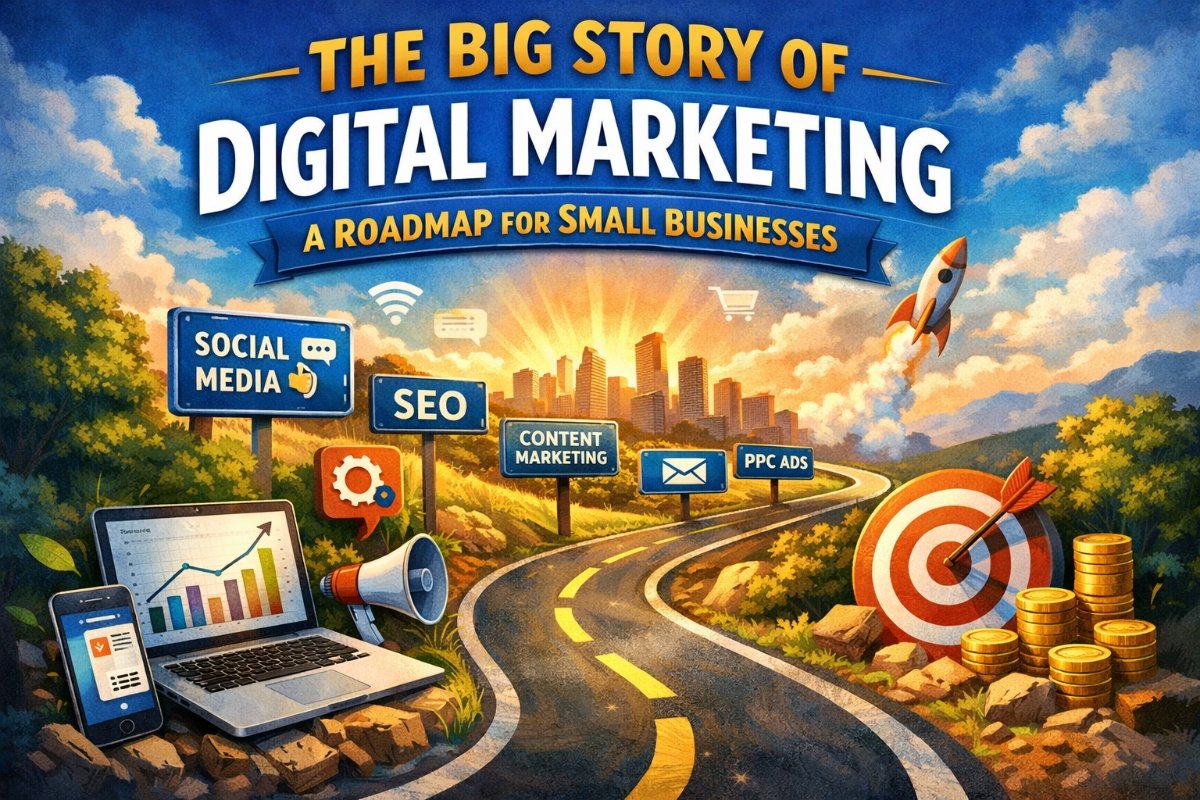
Today’s small businesses are operating in very competitive environments where it is a must to have a strong digital presence for growth and sustainability. Customers put out there that they are looking for products or services on search engines, social media, and in online reviews which in turn they use to determine what to go after.
For small business digital marketing is a chance to reach a larger audience, build brand credibility, and generate consistent leads without breaking the bank. But also in the digital space, success stories come from those who have a very clear road map that takes businesses through the process of getting visibility, attracting customers, and turning them into loyal clients.
A sound digital marketing plan starts with getting to know your target audience and setting out definite business goals. For small businesses, it is first to determine who their ideal customer is, what issues that customer is trying to solve, and which online spaces that customer frequents.
By this research, businesses are able to put together marketing strategies which in turn, better serve customer wants and preferences. As marketing efforts go in to play, which are in sync with customer behavior, we see better performance from campaigns that also produce better results in the long term.
Establishing a Strong Online Foundation
The first step in any digital marketing plan is to build out a strong online foundation. We see this as a professional website that clearly puts out what the company’s products, services, and brand value are. The site should be easy to use, mobile responsive, and have fast load times. Also in play is search engine optimization, which we do to make sure that our potential customers can very easily find us via online search.
Also very key is content marketing, which we put out there in the form of blog articles, guides, case studies, and other info resources that answer in detail what our customers’ questions are. High-quality content not only helps us in search engine results but also we position ourselves as the go-to authority in our field. Many small businesses today are into digital marketing services.
Social media is a key element in which brands put themselves forward. We see in platforms like Instagram, Facebook, LinkedIn, and YouTube how companies can connect with their audience and present themselves as authorities. What we are also seeing is that through regular updates, interaction with customers, and sharing of in-depth information, brands are in turn building a dedicated community of followers.
Key Strategies for Small Business Digital Marketing
Once online presence is established, businesses can put in place targeted strategies to acquire and convert customers. Also, we see which proven tactics are best for small businesses to use in their marketing.
- Invest in SEO to improve your online visibility.
- Use social media as a platform to connect with audiences and grow brand awareness.
- Build out email marketing campaigns to grow lead nurturing and customer relationships.
- Develop quality content which educates and informs potential customers.
- Track analytics to see how users behave and improve marketing campaigns.
These strategies put in place a framework for small businesses which in turn see continuous lead generation. Also, a key part of a solid go-to plan is paid advertising. As an example of that which works well, Google Ads and social media advertising are used to reach out to specific groups.
Also, we see that paid campaigns are very much at home when it comes to breaking into new markets, putting out word on new products, or announcing special deals. When paired with organic marketing efforts, paid advertising can really take a company to the next level. Also, many companies turn to a digital marketing agency in Dubai for professional input into complex strategies.
Agencies in this field will do things like search engine optimization, paid advertising management, content creation, and analysis reporting. Also, they bring to the table a level of experience that small business may not have and also which in turn can help to avoid typical mistakes and the in which we put put in place proven techniques that really do report back results.
Measuring Performance and Continuous Improvement
Digital marketing success is very much a function of data and performance tracking. In the case of small businesses, we see that they must, at regular intervals, look at key metrics like website traffic, engagement rates, conversion rates, and customer acquisition costs. From this, they determine what is working and what is not.
We note that we use tools like Google Analytics, search console reports, and social media insights at our disposal, which present to us great information on user behavior and performance of campaigns. By means of this data, which should be looked at regularly, businesses are able to fine-tune their marketing strategies and put forth what is proven to be the best channels.
Consistency is a key element in achieving long-term success. In the digital space, we are not at a point of a one-time play but a continuous process which requires you to update your content, to post new material, and to engage with your audience. Those who stay active online and put out relevant info are more likely to build trust and to get loyal customers. Also, in terms of results, we see that a well-thought-out digital marketing plan is what allows small players to do well in today’s digital world.
By creating a strong online presence, putting in targeted marketing efforts, and at the same time analyzing what is working and what is not, companies are able to attract new customers and to grow sustainably. With the right strategy and consistent work, digital marketing is to be looked at as a great tool that helps small businesses to increase their reach, to better their brand image, and to do well in the long run.