



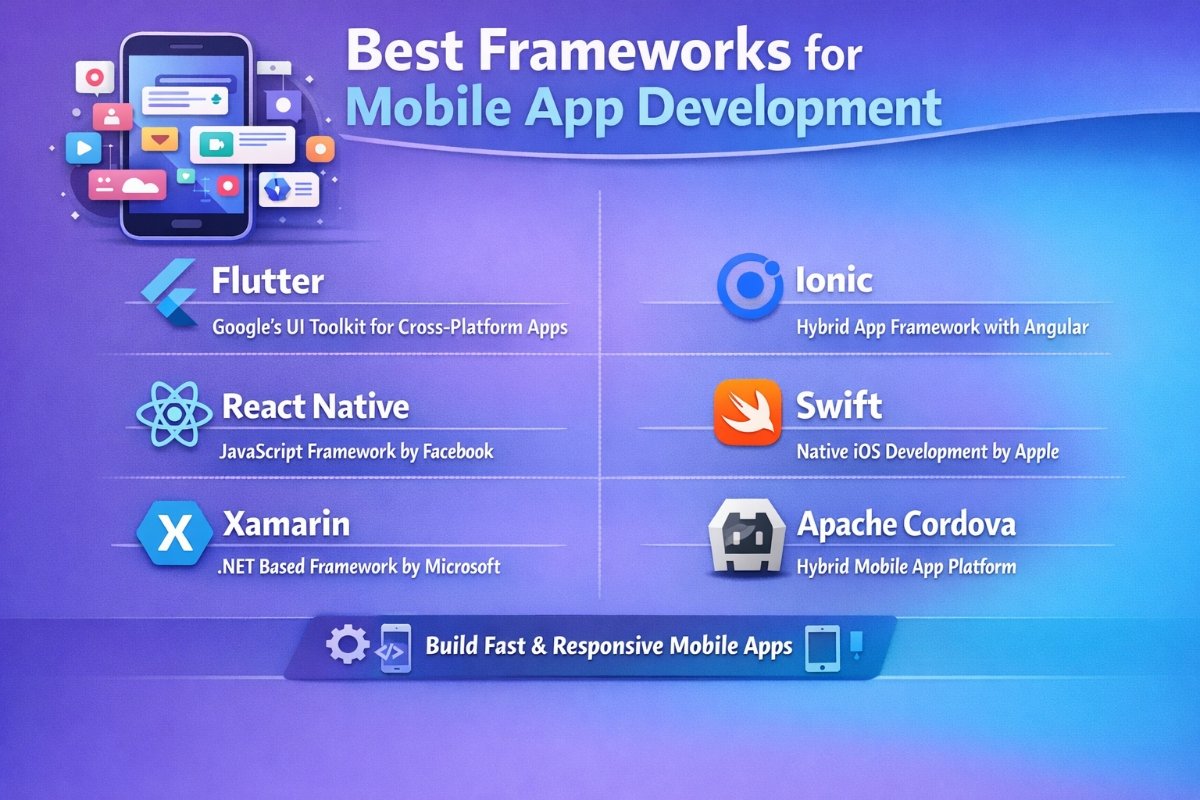
Mobile apps have become a basic element of today’s business plans. In every size of company, from the startup to the large enterprise we see that they are implementing mobile apps for customer engagement, service delivery, and improved operational efficiency. To develop a successful mobile app you must choose the right development framework. What you choose in this aspect will determine how well developers do at building out the app, its performance, and also how it will scale in the future.
Also as there are many frameworks available today, businesses must very carefully evaluate which technologies best fit with their project goals, budget, and long-term requirements.
Mobile frameworks present pre-coded tools, libraries, and components, which in turn simplify the app development process. Instead of building everything from scratch, developers may use these frameworks to speed up development, maintain the same performance levels, and ensure that what they develop is compatible across many devices.
Also choice of framework which is which to use plays a role in reducing development costs at the same time as it guarantees high quality user experience. In terms of what business has to decide between native apps or cross-platform apps is a big issue.
Native development is that which involves creating separate apps for platforms like iOS and Android using platform-specific programming languages. Cross platform frameworks in other hand do for which they develop a single code base that works across many platforms. Which of these approaches will benefit your project depends on the project’s complexity and performance needs.
Popular Frameworks Used in Mobile App Development
Many frameworks have taken off with developers for their flexibility, performance and large community support. In that which they do best these frameworks enable companies to put forth rich feature applications which in turn see great success.
- React Native: A very popular framework that allows developers to build cross-platform apps using JavaScript and React. It reports near native performance and has a very strong developer community.
- Flutter From Google comes Flutter, which uses the Dart programming language and which puts out high-performance UI with a single code base for Android and iOS apps.
- SwiftUI: A very modern framework that we see used for building iOS apps with Apple’s Swift language. It is great for developing intuitive and responsive interfaces that also perform very well.
- Kotlin Multiplatform: This platform which developers use to share code across many devices at the time which in turn preserves native performance. Microsoft supports Xamarin, which also allows developers to build mobile apps out of C# and .NET tech.
These frameworks are for development teams to improve at scale at the same time without trade off performance. We see that each framework brings to the table a set of benefits which are based on the project’s needs, development skill set, and the platform which they use.
Choosing the Right Framework for Your App
Select out that which framework to use is a function of many elements, like performance requirements, development time, scalability, and budget. For apps that require very high performance and in-depth device hardware interaction, native frameworks are the choice. Native apps usually perform better and give greater access to device features. But cross-platform frameworks are what businesses choose for a quick launch across many platforms.
By using a single code base, companies are able to reduce development costs and speed up product release. This is very much the case for start-ups and small businesses that wish to put their app ideas into the market fast. Also issue of skill in developer supply. Businesses that are building complex apps often choose to go the route of hire mobile app developers USA.
Performance, Scalability, and User Experience
While frameworks ease in development, what is true is that performance optimization is still very much of the essence for a great mobile experience. Applications must load fast, respond at the drop of a hat to user actions, and perform smoothly, which is also true when they are put to complex tasks. We see that developers get there by improving code efficiency, getting rid of background processes that don’t add value and in to which they implement better data management.
Also, in the design of the user interface, which is very much a key to mobile app success do we see that frameworks like Flutter and SwiftUI, which are very powerful in what they provide to developers in terms of UI elements. A well-designed interface, in turn, improves user engagement, gets users to spend more time in the app, and increases the chances of positive app store reviews.
Scalability is an issue of great importance to businesses that are looking at growth over the long term. As user demand goes up, applications must perform well under higher traffic. Cloud integration, modular architecture, and efficient backend systems are what help mobile apps to maintain stability and response as the user base increases.
Many companies work with mobile app development companies USA to see that they are using the best technologies and frameworks for their apps. Professional development teams usually do in-depth technical assessments, which are meant to determine the best solution for each project. This, in turn, helps businesses to avoid large-scale issues and also see the final product, which performs and scales as expected.
Conclusion
In that which is to say we put forth great value in choice of mobile app development framework as it directly influences application performance, development speed, and long-term scalability. By which we mean to say that through careful evaluation of what is available and which best meets project needs, companies can put together very powerful mobile applications, which in turn deliver a great user experience. Also which is true whether you choose native or cross-platform development, in the right framework which is put in the hands of skilled developers mobile apps will indeed remain very much competitive in today’s very digital marketplace.