


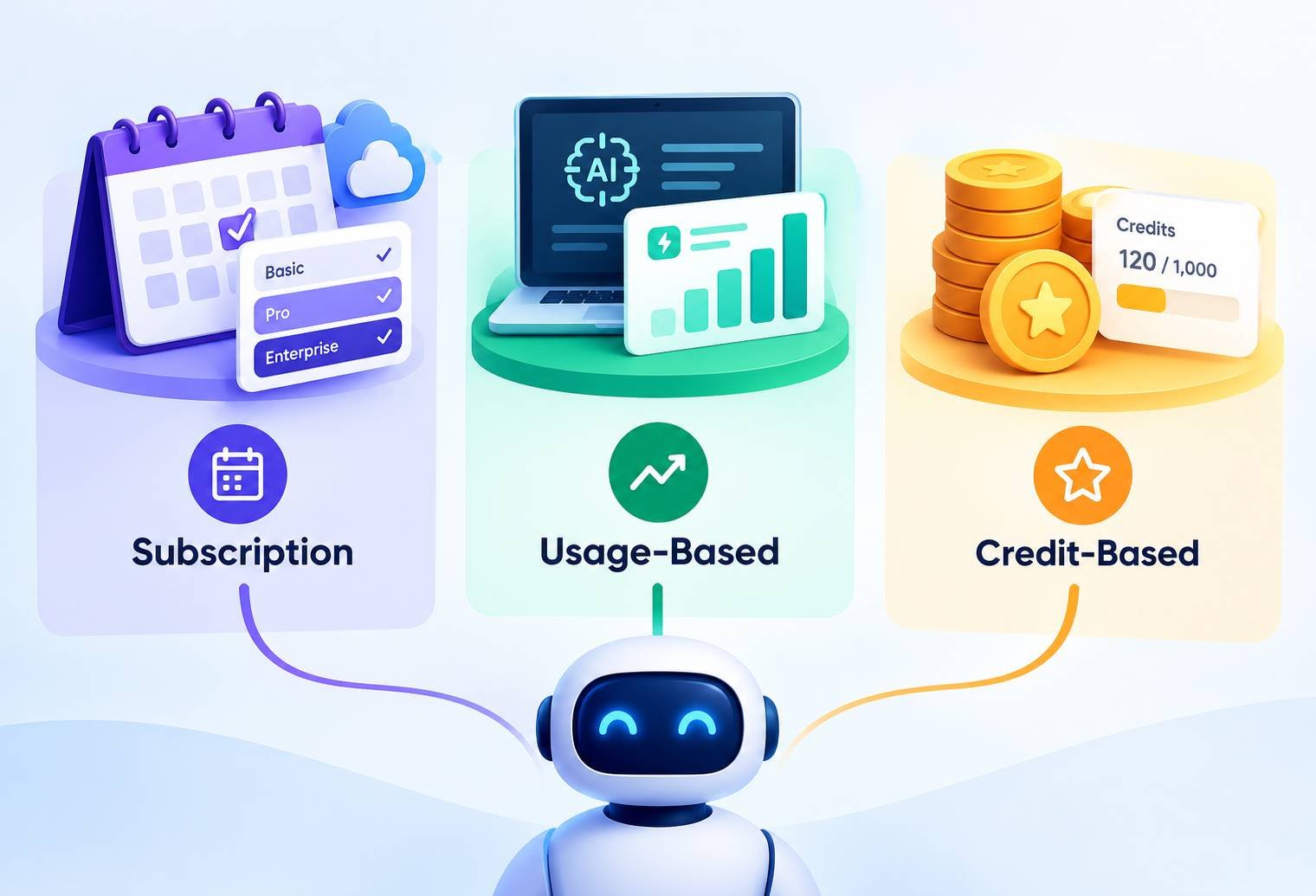
Most AI tools charge in one of three ways: a flat recurring fee, a meter that tracks what you consume, or a prepaid pool of credits you spend down. The label on the pricing page matters less than what the model does to your budget. A flat fee is easy to forecast but can penalize light users.
A meter rewards careful use and punishes surprises. Credits sit in between, and they are the hardest of the three to read at a glance.
This guide explains how each AI tool pricing model works, where each one tends to cause trouble, and how to compare them using your own usage numbers.
It also covers the extra questions healthcare organizations face when they buy AI, since pricing and compliance often get decided together.
The Three Models at a Glance
| Subscription | Usage-based | Credit-based | |
|---|---|---|---|
| How you pay | Fixed fee per user or per workspace, monthly or annually | Per unit consumed (tokens, requests, minutes, documents) | Prepaid or allotted credits, each action burns a set number |
| Cost predictability | High | Low to medium | Medium |
| Best fit | Daily, steady use by known people | Variable or automated workloads | Mixed workloads across different features |
| Common catch | Usage caps hidden behind “unlimited” | Costs climb with volume or longer prompts | Unclear conversion from credits to real work |
Many vendors blend two of these, which is covered further down.
Subscription Pricing: Pay for Access
Subscription pricing is the model most people meet first. ChatGPT Plus has been listed at $20 per month for individuals, and team plans typically charge per seat. At the time of writing, ChatGPT Business was reported at $25 per user per month, or $20 with annual billing, with a two-seat minimum. Treat any specific figure as a snapshot, because AI plan prices and tier names have changed several times in 2026.
Where Subscriptions Work Well
Subscriptions suit people who use a tool every day and need a budget line that doesn’t move. A 25-person marketing team on a $25 seat plan pays $625 a month whether the team writes 100 drafts or 1,000.
Finance teams like that. It also removes the hesitation that metered tools create, where staff avoid using the tool because they’re watching the cost.
Marketing teams are a common example, since content, research, and brand work tend to be steady and person-driven. If that’s your situation, the broader picture in AI Is Transforming Brand Marketing shows where these tools actually fit into campaign work.
What “Unlimited” Usually Means
Flat-rate plans almost always carry limits, even when the marketing says otherwise. Those limits show up as message caps per few hours, restrictions on the most capable models, slower responses at peak times, or separate allowances for features like deep research or code tools.
Higher tiers on consumer plans usually exist because heavy users kept hitting the lower caps, and they are priced as multiples of the base allowance.
Before committing a team to a subscription, test it during your busiest week. If people hit the cap on Tuesday, the plan is smaller than it looks.
Seat Math and Wasted Seats
Seat-based pricing assumes everyone uses the tool. In practice, a handful of people use it constantly and others log in twice a month. Audit actual use after 60 to 90 days and trim idle seats. Annual billing often lowers the per-seat price, but it also locks you in at a time when your needs may still be changing.
Usage-Based Pricing: Pay for What You Consume
Usage-based pricing charges for the work the tool performs. For language models, the standard unit is the token, a small chunk of text. Providers bill input tokens (what you send) and output tokens (what the model returns) separately, and output usually costs more per token.
Anthropic’s pricing documentation, for example, lays out per-million-token rates by model and notes that its Batch API processes requests asynchronously at a 50 percent discount on both input and output. Other tools in the same documentation, such as web search, carry their own per-use charges on top of token costs.
A Worked Example (Illustrative Only)
Suppose a company builds a support assistant that handles 10,000 conversations a month. Each conversation uses about 2,000 input tokens and 1,000 output tokens. Assume, purely for illustration, a rate of $3 per million input tokens and $15 per million output tokens. These are not any vendor’s actual prices.
- Input: 20 million tokens × $3 per million = $60
- Output: 10 million tokens × $15 per million = $150
- Monthly total: about $210
Double the conversation length and the bill roughly doubles. If some of that work isn’t time sensitive, such as overnight document classification, a batch discount of 50 percent would cut that portion in half. The point is that usage-based costs respond directly to design choices: prompt length, model selection, how much conversation history you resend, and whether you cache repeated context.
Why Finance Teams Get Nervous
Usage pricing is fair, since you pay for what you use, but it is hard to forecast before launch. A pilot with 20 users says little about what happens with 2,000. Agents and automated workflows add another wrinkle: one user request can trigger many model calls behind the scenes, so cost per task can run well above what a single prompt suggests.
Practical safeguards include setting spend limits in the provider’s console, tagging usage by project, and reviewing the bill weekly during the first two months.
Credit-Based Pricing: Pay in Units of Value
Credit-based pricing sits between the other two. You buy or receive a pool of credits, and each action draws some of them down. Image generators, video tools, and automation platforms use credits widely, and enterprise software vendors have adopted them for AI agents.
A concrete public example is Salesforce’s Agentforce. When it introduced Flex Credits, Salesforce priced 100,000 credits at $500, with each Agentforce action consuming 20 credits, or $0.10 per action. Salesforce described this as pricing per action rather than per conversation, so simple tasks cost less and complex ones cost more.
At that rate, a team running 5,000 actions a month would spend about $500. Salesforce’s pricing page also lists consumption-based and per-user license options, so the same product can be bought more than one way.
The Strengths of Credits
Credits give vendors a single currency across many features, and they give buyers a way to share a budget across teams without negotiating each feature separately. They also make it easier to compare light and heavy tasks within one product.
What to Check Before You Buy Credits
The weak point is translation. A credit is only useful if you can estimate how many you’ll burn on your real work. Ask these questions before signing:
- What does one typical task cost in credits, and does that change by model or feature?
- Do unused credits roll over, expire monthly, or expire annually?
- What happens when credits run out: service stops, overage billing starts, or you must buy a larger pack?
- Can credit costs change after purchase?
Credit models are also common in agent marketplaces, where each agent or action can have its own rate. If you’re evaluating that kind of setup, the overview of how an AI Agent Marketplace works can help you understand why per-action pricing is so common there.
Hybrid Pricing Is Common
Few products fit neatly into one box. A typical pattern is a base subscription that includes a monthly allowance, with metered or credit-based charges once you go past it. Another is a per-seat license for people plus usage fees for automated or customer-facing agents, which is how Salesforce describes its own Agentforce options.
Hybrids can be the fairest structure, but they take the most effort to model. Always ask what is included in the base price and what triggers extra charges.
How to Compare Models Using Your Own Numbers
Comparing sticker prices across models is nearly useless. A simpler method works better.
- Measure current or expected volume. Count users, tasks per week, or requests per month. If you don’t have data, run a two-week pilot.
- Convert each option to a monthly cost at three levels: your expected volume, half of it, and double it.
- Add the costs outside the price tag. Setup, integration work, admin time, training, and the cost of review when AI output needs human checking.
- Check the exit terms. Annual contracts, credit expiry, and data export rules all affect what switching costs.
If a subscription wins at expected volume but a metered option wins at half volume, you’ve learned something about how much your usage might swing. That tells you more than any single total.
Pricing and Procurement in Healthcare AI
Healthcare buyers add layers that general business buyers can skip, and those layers can shape pricing as much as the model itself.
First, many healthcare organizations buy AI through enterprise or marketplace channels instead of swiping a credit card on a consumer plan. Optum, a UnitedHealth Group subsidiary, launched the Optum AI Marketplace in June 2025 as a health care-specific platform for technology companies, providers, and payers, featuring products from Optum, ServiceNow, Microsoft, and Google.
The announcement I reviewed describes the platform’s purpose and partners but does not publish prices, so pricing for solutions listed there should be confirmed directly with Optum and the individual solution providers. Access terms and eligibility likewise vary by solution, and this article does not assume any particular pricing model applies to it.
Second, the plan you choose can determine whether a tool is usable at all for protected health information. Under HHS guidance on HIPAA and cloud computing, covered entities and business associates must meet applicable HIPAA obligations when using cloud services for electronic protected health information, and the guidance addresses the business associate agreement (BAA) in that context.
Whether a BAA is offered can differ by vendor, product, and plan tier, so a cheaper tier may simply be off the table for clinical or claims data. Confirm BAA availability in writing before you compare prices. The HHS page on HIPAA and cloud computing is the right starting point for what those agreements need to cover.
Third, when comparing marketplaces and direct vendor contracts, look at the total cost, including any marketplace fees, rather than the listed rate alone. For a broader look at how general-purpose marketplaces handle discovery and purchasing, the guide to the AI Marketplace USA is a useful companion.
Which Model Fits Which Situation
A few patterns hold up across most buying decisions:
- Individuals and small teams with daily use: subscription, because predictability beats optimization at small scale.
- Developers building products: usage-based, since the cost follows customer volume and you can use batching and caching to control it.
- Departments testing several AI features: credits, as long as the credit-to-task conversion is clear and expiry terms are reasonable.
- Customer-facing automation with unpredictable traffic: usage or credits with firm spending limits, never an uncapped meter.
- Regulated settings such as healthcare: start with compliance and contract terms, then price the tiers that qualify.
Frequently Asked Questions
What is the difference between subscription and usage-based AI pricing?
Subscription pricing charges a fixed fee for access, usually per user, regardless of how much you use the tool within its limits. Usage-based pricing charges for the amount you consume, such as tokens or requests, so the bill rises and falls with activity.
How do credit-based AI tools work?
You receive or buy a pool of credits, and each action uses a set number. The cost per action can vary by feature or model, so the useful question is how many credits your typical task consumes.
Which AI pricing model is cheapest?
It depends on volume. Subscriptions tend to win for steady, heavy individual use, and usage-based pricing tends to win for light or irregular use. Calculate each at your own expected, low, and high volumes.
Why do AI tools have usage caps if they say “unlimited”?
Running AI models costs the vendor real compute for each request. Caps, throttling, and model restrictions let vendors offer a flat price without losing money on the heaviest users. Read the plan details, not just the headline.
Do credits expire?
Sometimes. Policies vary by vendor and plan, so check whether unused credits roll over before buying a large pack.
Is the Optum AI Marketplace free?
The launch announcement I reviewed does not list prices, and I could not verify a public pricing model. Contact Optum or the solution providers for current terms.
Does the AI tool I choose need to support HIPAA?
If the tool will handle protected health information on behalf of a covered entity or business associate, HHS guidance points to a business associate agreement with the service provider. Ask the vendor whether a BAA is available for the specific product and plan you intend to buy.
Final Takeaways
Pick a pricing model by looking at how your usage behaves, not at the plan names. Steady, people-driven work leans toward subscriptions. Variable or automated work leans toward metering. Credits can work well when you can translate them into real tasks.
A practical next step: pull one month of expected usage, price your top two vendor options at low, expected, and high volume, and ask each vendor three questions: what the cap is, what happens at the limit, and what you pay beyond it. That exercise takes an afternoon and usually settles the decision.
Published by BigStories.